Use code WELCOME10 for 10% off· Free shipping over $300
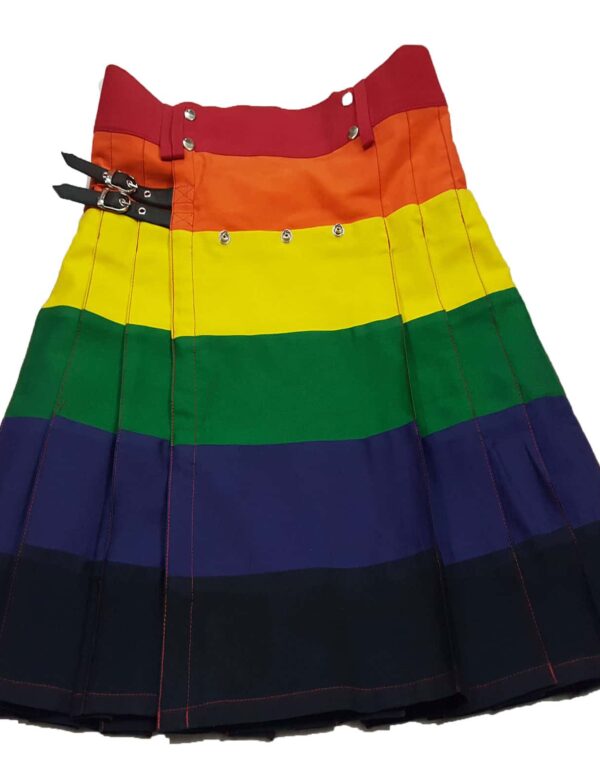
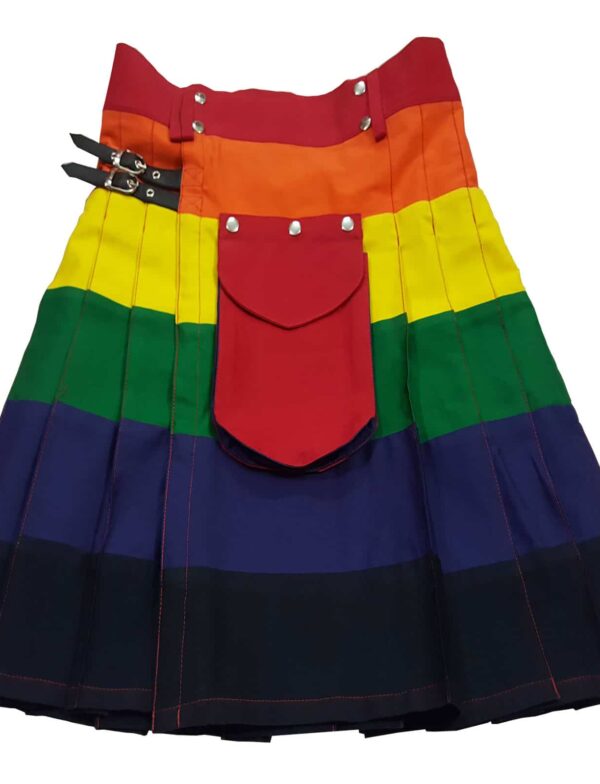
About our pride kilts
Pride kilts for every flag, made to your measurements since 2017
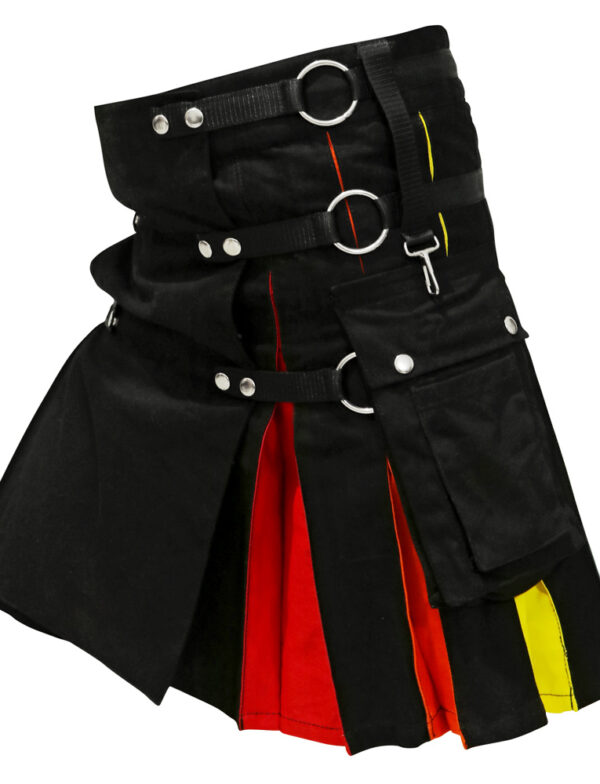
Kilt & Jacks has been making pride kilts by hand since 2017, and we make them for every flag on the spectrum — not just the rainbow. Every pride kilt we ship — whether classic rainbow, trans, bisexual, pansexual, lesbian, asexual, non-binary, genderfluid, or any of the other flags in our range — is drafted from three measurements you send us: waist at the natural waistline (not the trouser waist, which is the single most common measurement mistake), hip at the widest point, and length from waist to the middle of the kneecap. There is no factory sizing. There is no closest fit. Prices from $109, in polycotton twill with reinforced construction.
Why one brand, every flag
Most kilt makers who stock pride kilts stock the six-stripe rainbow and stop. If you're bi, trans, ace, non-binary, or fly any other flag, you're usually told to "make do with rainbow" — which most people in the community understand is not the same thing. Different flags mean different communities, different histories, and different pride. Getting that right matters. So we make them all — every recognised pride flag with an established colour sequence, cut to the same wraparound kilt silhouette, in the same quality construction, at the same starting price.
Pride kilts have no historical connection to Scottish Highland dress. They're a modern celebration garment — worn to Pride marches, festivals, gigs, weddings, drag shows, and daily wear by anyone who wants to fly their flag in a way clothing lets them. They're worn by people across every letter of LGBTQIA+, by allies at Pride events, and by anyone who wants a kilt that reads celebratory rather than traditional. For a Scottish wedding, Burns Night, or clan ceremony under a traditional dress code, the correct choice is a Scottish tartan kilt, not a pride one.
Materials and construction
We work in polycotton twill for pride kilts — the same 65% polyester, 35% cotton blend used in our camouflage range — chosen because it holds print colour longer than pure cotton, resists fading through wash cycles and sunlight, and stands up to festival wear without losing the vibrancy of the flag colours. Weight is 10oz — light enough for summer Pride events, structured enough to hold the pleats through a full day of marching, dancing, and celebrating.
Colours are printed sublimation-style, which bonds the dye to the fibre rather than sitting on the surface — the result is prints that don't crack, peel, or fade the way screen-printed fabrics do. Pleats are stitched permanently, which holds the flag pattern aligned through movement. Belt loops are reinforced with double-stitched bar tacks. Hardware is solid brass or matte black. Every pride kilt is inspected against the measurements you sent us before it ships.
The pride flags we make
The list below is what we stock as standard. If you fly a flag that's not here, message us — if it has an established colour sequence, we can usually make it.
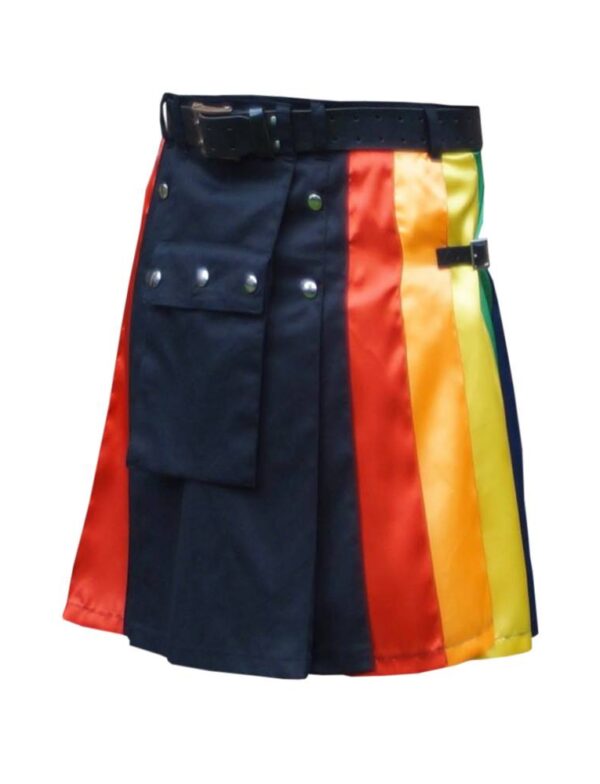
Rainbow (Gilbert Baker / classic six-stripe). Red, orange, yellow, green, blue, violet. The universal pride flag, designed by Gilbert Baker in 1978 and used across the LGBTQIA+ community and by allies at Pride events worldwide. Our best seller.
Progress Pride (Daniel Quasar, 2018). The classic rainbow with an added chevron in black, brown, light blue, pink, and white — representing people of colour within the community, trans people, and those lost to HIV/AIDS. The most inclusive current iteration of the pride flag.
Transgender pride (Monica Helms, 1999). Light blue, pink, and white stripes. Worn to represent trans identity and by trans people, allies, and at Transgender Day of Visibility events.
Bisexual pride (Michael Page, 1998). Magenta, purple, and blue. The overlap of magenta and blue in the purple middle stripe symbolises attraction to more than one gender.
Pansexual pride. Pink, yellow, and blue horizontal stripes representing attraction to people regardless of gender identity.
Lesbian pride (five-stripe or seven-stripe variant). Shades of orange, white, and pink. Available in the modern five-stripe design or the earlier seven-stripe version — specify at checkout.
Asexual pride. Black, grey, white, and purple horizontal stripes. Worn by ace, demi, and grey-ace individuals at Pride events and daily.
Non-binary pride (Kye Rowan, 2014). Yellow, white, purple, and black stripes representing gender identity outside the binary.
Genderfluid, genderqueer, agender, aromantic, and intersex flags. All available as standard, in their recognised colour sequences and stripe patterns.
Custom flag combinations, allyship flags, and specific community variants are available on request. We don't offer designs that would combine or misrepresent flag identities — each pride kilt is made to fly one flag correctly.
Choosing your pride kilt
Choose the flag that represents you. That's the whole choice. There's no wrong pride kilt to buy for the flag you fly. If you're an ally buying to wear at Pride in support, the rainbow or Progress Pride flags are the standard allyship choice — they're inclusive of the whole community rather than representing a specific identity. If you're buying for a partner, family member, or friend and want to check their flag preference without ruining the surprise, we can hold an order under a temporary flag choice while you confirm — just ask.
Every pride kilt ships in ten working days, is cut and stitched by hand at our workshop, and is guaranteed to fit the measurements you sent us. If it doesn't, we remake it. See our returns policy for full terms. Pride is one of several styles of men's kilts we make — see also utility, Scottish tartan, and hybrid styles.
Every flagRainbow, trans, bi,
ace, and more
ace, and more
10 daysCut, stitched,
shipped
shipped
Fade-resistantSublimation-printed
polycotton
polycotton
Free remakeIf the fit isn't
perfect
perfect
Frequently asked
Questions before ordering
What is a pride kilt?
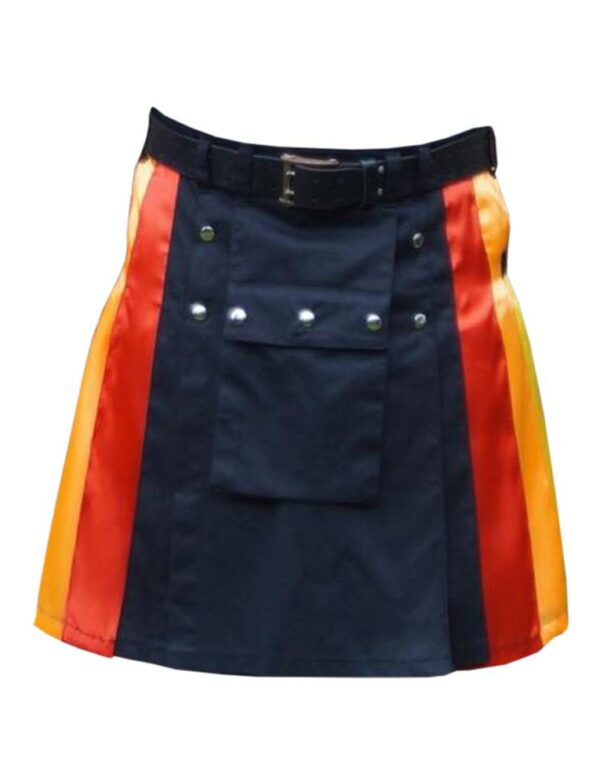
A pride kilt is a kilt printed or panelled in the colours of an LGBTQIA+ pride flag — most commonly the rainbow, but also the trans, bisexual, pansexual, lesbian, asexual, non-binary, and other community flags. It keeps the wraparound silhouette of the traditional Scottish kilt but replaces tartan or plain fabric with pride flag colours, worn as a celebration garment for Pride marches, LGBTQIA+ events, festivals, weddings, and daily wear. Pride kilts have no historical connection to Scottish Highland dress; they're a modern garment worn by people across every letter of the community and by allies.
Do you make kilts for every pride flag or only the rainbow?
Every recognised flag with an established colour sequence. Our standard range includes the classic rainbow (Gilbert Baker), Progress Pride (Quasar 2018), transgender, bisexual, pansexual, lesbian, asexual, non-binary, genderfluid, genderqueer, agender, aromantic, and intersex flags. If you fly a flag that isn't in our standard range — a specific community variant, allyship flag, or newer design — contact us and we'll usually make it, provided it has an established colour sequence. We don't combine flag identities or make composite designs, since each pride flag has a specific meaning that shouldn't be blurred.
Do I have to be part of the LGBTQIA+ community to wear a pride kilt?
No. Anyone can wear a pride kilt — LGBTQIA+ people wear their own flag or another community's flag as solidarity, and allies wear pride kilts at Pride events, marches, and celebrations to show support. If you're an ally, the rainbow (Gilbert Baker) or Progress Pride flags are the standard allyship choices, since they represent the whole community rather than a specific identity. Wearing a specific community flag as an ally is fine but reads more as identifying with that community — some people prefer to keep specific-flag garments for people in that community, others don't mind. Follow your own judgement and the norms of your local community.
Are pride kilts machine washable?
Yes. All our pride kilts are polycotton twill, machine washable in cold water on a gentle cycle. Air dry to preserve the pleat structure — avoid tumble drying, which can fade colours over repeated cycles and distort sewn-in pleats. Wash inside-out to protect the printed face. Because our prints are sublimation-bonded to the fibre rather than surface-printed, they don't crack, peel, or wash out; expect the colours to stay vibrant through years of festival and daily wear.
Can I wear a pride kilt to a wedding?
Yes — pride kilts are increasingly worn at LGBTQIA+ weddings and at weddings where the couple wants to celebrate identity as part of the ceremony. They work particularly well for grooms, groomsmen, and guests at same-sex and queer weddings, and at any wedding without a strict traditional dress code. For weddings requiring formal Highland dress (traditional Scottish, Burns Night formal, clan ceremonies), a tartan kilt is the expected garment — see our Scottish tartan kilts for those occasions. Some couples wear a tartan kilt for the ceremony and change into a pride kilt for the reception — that's a beautiful tradition that's becoming more common.
How do you style a pride kilt?
The most common styling is deliberately joyful — a plain white or black tee, or a graphic tee celebrating identity, community, or a specific Pride event. Chunky sneakers, boots, or Doc Martens work with any pride flag. For daytime marches and festivals — sunglasses, a bucket hat or cap in a complementary colour, and light layers you can add or remove as the day heats up. For evening Pride events and clubs — heavier boots, a jacket that lets the kilt be the statement, and any accessories that flag your identity or community. A plain leather or fabric belt in black or brown reads best across every flag. Fishnets, tights, or plain socks underneath are all standard, depending on your own style — pride kilts have no gendered styling rules and reward personal expression.